
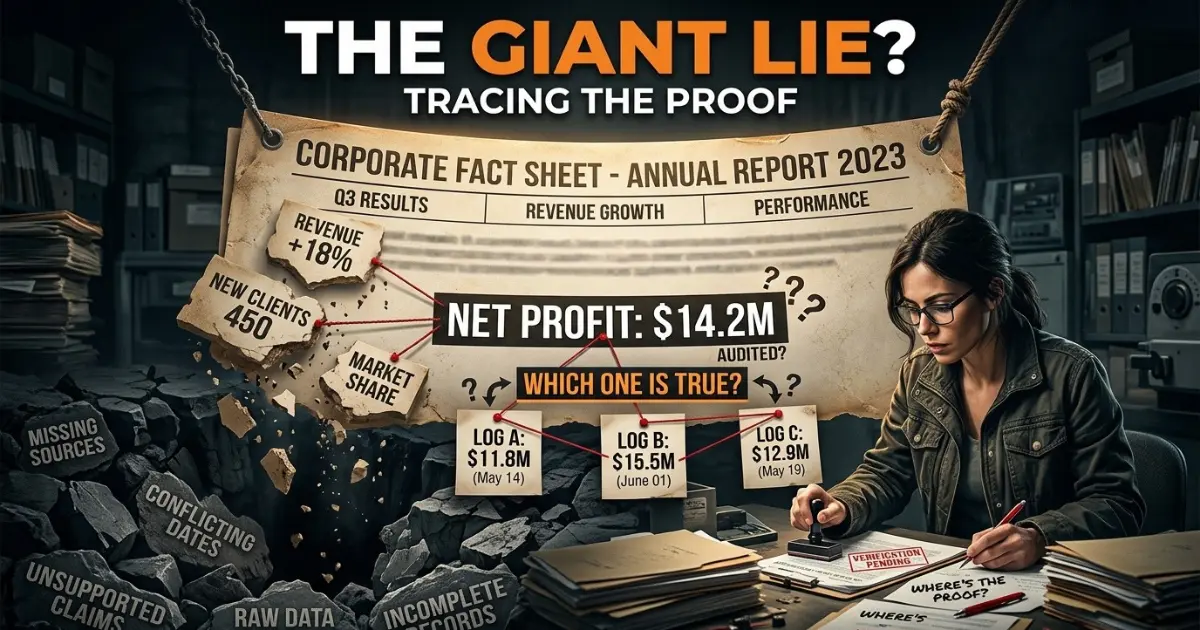
A research dossier for target company is a working file, not a polished summary. It brings together what you know about a business, where each fact came from, and when you checked it — so the research can be trusted, reused, and handed off without someone having to redo it from scratch.
Most company profiles tell you what a business does. A dossier goes further: it keeps the evidence trail behind every claim, so a colleague — or you, six months later — can see exactly how a fact was verified.
Before building one, make sure you’ve got the right company in the first place. A near-identical name or an old brand can send an entire dossier down the wrong path. If you are not sure which company you are researching, start with our guide on Target Company URL Research before building the dossier.
What Makes a Dossier Different From a Profile or a Report
A profile is a snapshot. It might say “the company has offices in several countries” and stop there.
A dossier says more: London office listed on the company’s locations page, checked September 2026, source: official website. That single line tells you what was found, where it came from, and how current it is — which is what makes the dossier useful months later.
A research report, on the other hand, is what you build from a dossier. The report is the finished analysis. The dossier is the raw, sourced material that made the report possible — facts, open questions, conflicting claims, and all.
Start With a Question, Not a Blank Page
The biggest mistake in company research isn’t missing information — it’s collecting too much of the wrong kind. Without a clear objective, a dossier turns into a pile of facts nobody ends up using.
The same company needs a completely different dossier depending on why you’re researching it. A sales team cares about products, company size, leadership, and recent hiring. A supplier-vetting team cares about ownership, manufacturing sites, and certifications. A competitor analysis leans on pricing, positioning, and market activity.
So write the objective at the top before you open a single browser tab:
Research objective: Understand whether this company could be a potential enterprise software buyer. Scope: Business model, employee size, products, technology, locations, leadership, recent hiring. Excluded: Detailed financial analysis.
That one paragraph will save hours of research that never gets used.
What to Include (Pick What Fits Your Goal)
Not every dossier needs every section below. A software company research file leans on product and technology details; a manufacturer’s file leans on facilities and supply chain. Use this as a menu, not a checklist you have to fully complete.
Company identity. Legal name, website, headquarters, industry, and parent or sibling companies if the business sits inside a larger group. This is where you confirm you’re researching the right entity. Use the official company registry for the country or jurisdiction where the business is registered. The exact records available vary by country.
Company overview. What the business actually does, in plain language — not a copy-paste of the About page. A good overview answers one question: what does this company do, for whom, and in what part of the market?
Products and services. Group related offerings instead of listing every item from a navigation menu. For each one that matters to your research, note what it is, who it’s for, and what problem it solves.
Markets and customers. Be careful here — there’s a real difference between “the company serves healthcare organizations” (a general market claim) and “Company X is a customer” (a specific claim that needs its own evidence). Don’t let the first one quietly become the second.
Locations. Keep the type of location clear. A registered office isn’t automatically a headquarters, and a sales office isn’t a manufacturing site.
Leadership. Research the people relevant to your goal, not every name that shows up in a search. For public US companies, proxy filings and SEC documents are useful here alongside the company’s own site.
Company size. Numbers like employee count or revenue need context, not just a figure. “500+ employees, reported by [source], checked September 2026” tells a reader far more than “Employees: 500+” on its own — and it ages honestly.
Ownership and structure. Parent companies, subsidiaries, and business units. Don’t mix a parent’s revenue or leadership with a subsidiary’s — they’re often different businesses with different numbers.
Business model. How the company actually makes money, based on evidence — filings, investor material, or product documentation — rather than an assumption based on its industry.
Financial information, when it’s both relevant and available. Public companies disclose far more than private ones; a 10-K gives an annual view, a 10-Q a quarterly one, and an 8-K covers material events. Always attach a reporting period to any figure you record.
Technology, only if it matters to your question — central for a software company, secondary for most manufacturers.
Competitors, defined by market and customer overlap rather than gut feeling. Instead of labeling something a “top competitor,” write down why it’s relevant and what evidence supports that.
Partnerships. A logo on a partner page isn’t proof of an active relationship — check whether it’s current before you record it as one.
Recent developments. New products, leadership changes, funding, expansion. Date everything; a three-year-old announcement is historical context, not current news.
Hiring and other signals. A job posting is a fact. “The company may be expanding its engineering team” is your interpretation of that fact. Keep the two clearly labeled — this distinction matters more than almost anything else in the whole dossier.
Where to Actually Look
Start with the company’s own website — About, Products, Leadership, Locations, Careers, and Investor Relations pages usually cover most of what you need first.
For legal and registration details, use the official registry that matches the company’s country or jurisdiction. For US public companies, SEC filings through EDGAR — 10-Ks, 10-Qs, 8-Ks, S-1s — can provide detailed financial and structural information. Other countries have their own registries and filing systems.
Independent sources — trade publications, industry news, regulatory records — fill in what the company won’t say about itself. Company sources tell you what the business wants you to know; independent sources tell you what happened around it.
A Step-by-Step Process
- Define the objective and scope. Write down the question you’re trying to answer, and what’s explicitly out of scope.
- Confirm the company’s identity. Rule out parent companies, subsidiaries, brands, and similarly named businesses before going deeper.
- Find the strongest primary sources for the jurisdiction and company type — don’t settle for a generic directory when a registry or filing is available.
- Build the core picture: identity, business, products, markets, locations, leadership, structure.
- Check ownership and structure carefully, especially for larger groups where multiple legal entities can show up in search results.
- Add the goal-specific research — financials, technology, hiring, competitors, whatever your objective calls for.
- Look for recent changes that could make earlier findings outdated.
- Cross-check the claims that matter most — ownership, leadership, financials, employee counts, major partnerships. If two sources disagree, record the conflict instead of picking one silently.
- Attach a source and date to every important fact.
- Separate fact from inference, every time.
- Write down open questions rather than leaving gaps invisible.
- Check the dossier against your original objective before calling it done. If it doesn’t answer the question, go find what’s missing — don’t pad it with unrelated facts.
Keeping Evidence Next to the Claim
The simplest way to make a dossier useful later is a lightweight table for each important claim:
| Claim | Source | Source type | Date checked | Status |
|---|---|---|---|---|
| Company lists London as an office location | Official website | Company | Sept 2026 | Confirmed |
| Company has 500+ employees | Named source | Third party | Sept 2026 | Reported |
| Hiring may indicate engineering team growth | Job postings | Signal | Sept 2026 | Inference |
That last row matters: the hiring itself is evidence. Why the company is hiring is your interpretation. Keeping “Status” as its own column stops the two from blurring together.
Cross-Checking, Without Overdoing It
You don’t need five sources for every sentence — only for the claims that would change the meaning of the dossier if they turned out to be wrong: ownership, leadership, financial figures, employee counts, major partnerships, and anything recent enough to still be in flux.
If a website gives one legal name and a registry gives another, that’s worth resolving. If two sources report different employee counts, check whether they’re measuring the same thing at the same time — “employee count” isn’t a fixed definition across sources.
A primary source isn’t automatically the newest source. A filing can be completely accurate for its reporting period and still be outdated on current leadership. Source, date, and context together matter more than the source name alone.
A Simple Template
Research Dossier for Target Company
Use this template to collect company facts, sources, dates, open questions, and conflicting information in one place.
Strip out any area that doesn’t serve your objective. A small private company might only need five of these; a large public one might need all fifteen.
Common Mistakes Worth Avoiding
- Researching the wrong company. A similar name, an old brand, or a subsidiary mistaken for the parent can derail everything that follows.
- Mixing parent and subsidiary data. Different revenue, different leadership, different products — keep them apart.
- Relying on one source. Even a good source is usually incomplete on its own.
- Recording facts without dates. A five-year-old figure isn’t wrong — it’s just undated, which makes it useless later.
- Treating search results as evidence. They help you find sources; they aren’t sources themselves.
- Presenting an inference as a fact. This is the single most common way a dossier misleads someone downstream.
- Assuming absence of evidence means absence of fact. If you can’t confirm something, write “no reliable public source found” rather than guessing.
How Often to Update It
There’s no fixed schedule — it depends on how fast the company changes and how the dossier is being used. A background profile might need a light review every few months. An active sales account or a company going through visible change deserves more frequent checks, especially on leadership, ownership, status, products, and major announcements.
Company Research Dossier: What Researchers Usually Ask
What is a research dossier for a target company? A structured file about one company that keeps the evidence — sources, dates, notes, open questions — behind every fact, not just the facts themselves.
How is it different from a company profile? A profile is a summary. A dossier keeps the sourcing and research trail behind that summary, which is what makes it reusable.
What sources should I use? Start with the company’s own website, then add the registry or filings that match its jurisdiction, plus independent news or trade sources for anything the company won’t disclose itself.
Should it include financial information? Only when it’s relevant to your objective and actually available — public companies disclose far more than private ones.
How do I handle conflicting information? Don’t pick one silently. Record both claims, check their dates and definitions, and note what’s still unresolved.
Can this process be automated? Source discovery, data collection, and monitoring can be automated to a point. Judging whether two records describe the same company, or whether a signal actually means something, usually still needs a person.
The Short Version
Confirm the right company. Write down the objective before you start collecting facts. Use sources that match the claim you’re checking. Attach a date to everything. Keep facts and interpretations in separate columns. And when you can’t verify something, say so instead of guessing.
That’s what turns a pile of search results into a dossier someone can actually trust and reuse.
You Might Also Like:
Vencoing Com: Login, Sign Up & Is It Safe?
Adswynk Com: The Truth Behind Its Claims, Features & Current Status

Hi, I’m Emma Rose, the creative founder of Punstation.com. With a background in crafting hundreds of engaging guides and clever wordplay, I specialize in making complex information easy and fun to digest. Whether I’m exploring technical trends, lifestyle ideas, or creating my signature witty puns, my goal is to provide useful, well-researched content that helps solve problems and brings a smile to your face. For me, every topic, from tech to humor, is an opportunity to share clear, practical insights with a fresh perspective.