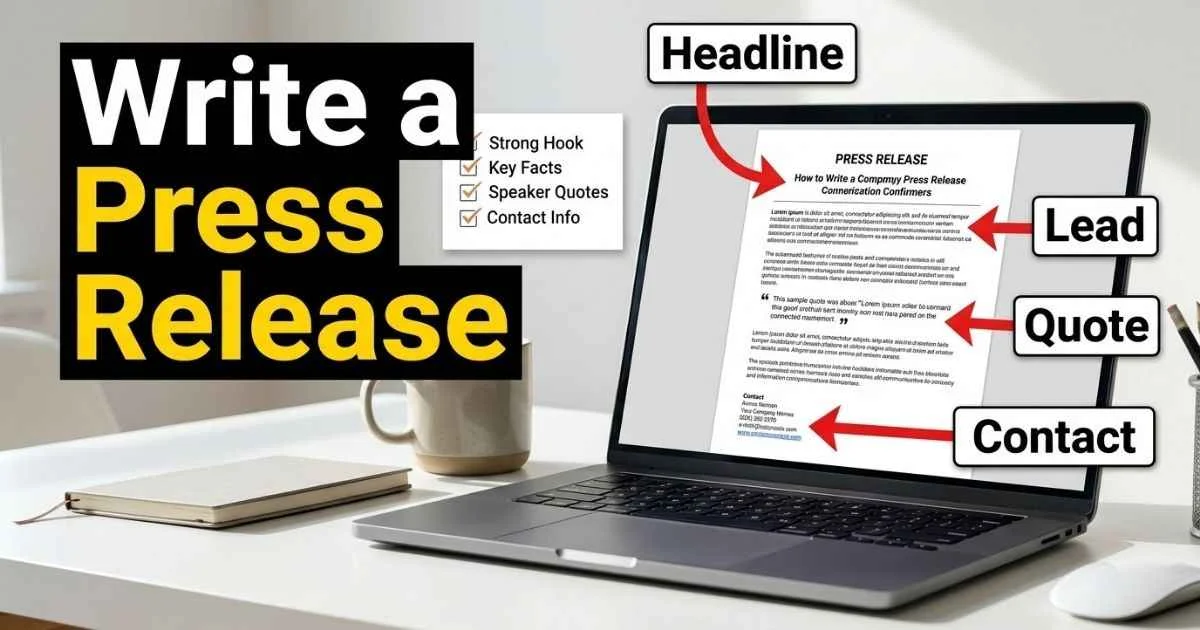
To learn how to write a press release, start with the news, not your company history. A strong release tells readers what happened, why it matters, and what comes next. It uses a clear headline, strong lead, useful quote, key facts, company boilerplate, and media contact.
The easiest process is:
- Make sure the information is newsworthy.
- Identify the people who need to know.
- Write a clear headline.
- Add the dateline and lead.
- Build the body with facts and context.
- Add a quote that adds new information.
- Finish with the boilerplate and contact details.
- Edit, fact-check, and send it to the right people.
The goal is simple: make the story easy for a journalist or reader to understand and use.
Decide Whether Your News Needs a Press Release
Before you write anything, ask one question:
What is new here, and why should anyone care?
A press release presents newsworthy information about a person, event, service, product, or organization. This broader summary includes information about an organization as well as the types of news Rutgers lists. It gives an editor or reporter information they can consider for coverage. Rutgers describes newsworthiness as a key purpose of a press release.
What makes an announcement newsworthy?
Examples of reasons to write a press release include:
- A new product or service launch.
- A major funding round.
- A merger or acquisition.
- A new business opening.
- A major partnership.
- A new executive appointment.
- An important award.
- New research or original data.
- A public event.
- A community or nonprofit project.
- A recall, safety notice, or major public update.
- A milestone that matters to your audience.
These are examples, not fixed rules. The best choice depends on whether the information is new or useful to your target audience.
For example, “Our company hired a new office manager” may not be strong news.
But fictional example: “Northstar Health appoints new CEO to lead expansion into rural clinics” gives readers a clearer reason to care.
When a press release is the wrong format
Not every announcement needs a press release.
| If your goal is… | Consider using… |
|---|---|
| Tell journalists about important company news | Press release |
| Invite reporters to an upcoming event | Media alert |
| Get one journalist interested in a story | Media pitch |
| Explain a topic to your customers | Blog post |
| Share a short customer update | |
| Announce an investor-focused update | Investor communication |
| Share a quick update with followers | Social media post |
A press release gives the main announcement and key supporting information. A media alert or advisory usually tells journalists about an upcoming event or photo opportunity.
Gather the Facts Before Writing
Do not start by trying to sound impressive. Start by collecting facts.
As a recommended benefit, this can make the writing faster and may help you avoid weak claims.
Answer the 5 Ws and H
Write down the answers before drafting.
| Question | What to identify |
|---|---|
| Who? | Company, people, partners, and affected audience |
| What? | The exact announcement |
| When? | Release date, launch date, deadline, or event date |
| Where? | Location, market, venue, or area affected |
| Why? | Why the news matters |
| How? | How it works, what happens next, or how people can respond |
You do not need to force every answer into one sentence. The goal is to make sure the important facts are covered.
This follows the inverted-pyramid approach, which puts the most important information first. Then you add details and background.

Verify names, numbers, dates, and claims
Before sending the release, check:
- Names and spellings.
- Job titles.
- Dates and times.
- Statistics and research.
- Product names.
- Partner names.
- Quote wording.
- Website links.
- Phone numbers and email addresses.
- Company description.
- Claims such as “first,” “largest,” or “only.”
If you cannot prove a claim, rewrite it or remove it.
A simple fact is usually stronger than a big claim you cannot support.
Use the Standard Press Release Format
A clear format helps readers and journalists find key information. Common sections include a release status, headline, optional subheadline, dateline, lead, body, quote, boilerplate, contact information, and an end mark. Formats can vary, so not every release must use every section.
Rutgers lists the headline, subhead, dateline, lead, inverted pyramid, quote, boilerplate, close, and contact information among the main parts of a release.
Release status
Many releases begin with:
FOR IMMEDIATE RELEASE
As a common convention, this signals that the sender has not placed a publication restriction on the release.
If you are using an embargo, clearly show the allowed publication date and time, including the time zone when needed.
As a recommendation, use an embargo only when there is a clear reason to request a later publication time.
Headline
Your press release headline should state the news clearly.
A suggested formula is:
[Organization] + [active verb] + [specific announcement] + [important result]
For example:
Fictional example: Northstar Health Launches Remote Monitoring Program for Rural Clinics
This is stronger than:
Northstar Health Announces an Exciting New Healthcare Solution
The first headline tells us what happened. The second mainly uses promotional language.
Subheadline
A subheadline is optional.
Use it to add one useful fact that does not fit in the headline. It could show the audience, location, date, number, or result.
Do not use it to repeat the headline.
Dateline and lead paragraph
The dateline commonly gives the release location and date, but formats vary by publication and country.
The lead paragraph tells readers the main news as quickly as possible.
One possible lead formula is:
[City, Country] — [Organization] announced [main news] on [date], giving [audience] [result or benefit].
Your lead should answer the most important questions first.
Do not begin with your company’s history. Do not make readers wait until paragraph three to discover the news.
Supporting body
Use the body to add facts and context.
You might include:
- A key statistic.
- Research findings.
- Product details.
- Event information.
- Customer impact.
- Partner information.
- Background needed to understand the news.
- What happens next.
- A useful link or resource.
Keep each paragraph focused on one idea.
Quote
As writing guidance, a good quote should add something useful that the rest of the release does not say as well.
It can explain:
- Why the announcement matters.
- What problem it solves.
- What the organization learned.
- What customers or communities can expect.
- Why the change is happening now.
Avoid a quote that simply repeats the headline.
Weak:
“We are excited to launch our new program,” said Jane Smith.
Stronger:
Fictional quote: “Rural clinics often have fewer tools for tracking patients between visits,” said Jane Smith, Northstar Health’s CEO. “This program gives care teams a simple way to spot problems earlier.”
The second quote gives the reader useful context.
Boilerplate
A boilerplate is a short description of your organization that can appear at the end of releases.
It should explain:
- What the organization does.
- Who it serves.
- Its main area of work.
- Where readers can learn more.
Keep it factual. Update it when your company changes.
Contact information and end mark
Add a media contact at the end.
Include:
- Name.
- Job title.
- Email.
- Phone number.
- Website.
A common end mark is:
###
Other endings may depend on the organization or publication.
Write the Headline and Lead First
Once you have your facts, write the headline and lead before filling in the rest.
If those two parts are weak, the whole release will feel unclear.
Weak versus stronger headline
Weak:
Company Announces Exciting New Solution
Stronger, fictional example:
Northstar Health Launches Remote Monitoring Program for Rural Clinics
The stronger headline is an example of a clearer headline because it names the company, states the action, and explains the subject.
It also avoids words such as “revolutionary,” “amazing,” and “world-class.” As a writing recommendation, avoid these words unless you can prove them.
Lead paragraph example
Fictional example:
AUSTIN, Texas — Northstar Health launched a remote monitoring program for rural clinics on Tuesday.
This lead quickly tells us:
- Who: Northstar Health.
- What: It launched a monitoring program.
- Where: Austin, Texas.
- When: Tuesday.
- Who is affected: Rural clinics.
A well-written lead should give a journalist the main facts before the rest of the release.
Press Release Template
Use this press release template as a starting point. Replace every placeholder with specific, verified information.
FOR IMMEDIATE RELEASE

[Clear headline]

[Optional subheadline]

[City, State/Country] — [Organization] announced [main news] on
[date]. The announcement matters because [reason or impact].

[Add an important fact, result, statistic, or piece of context.]

[Explain what happens next, who can participate, or where readers
can find more information.]

“[Quote that adds insight or explains the significance],” said
[Name, title, organization].

[Optional second quote from a partner, expert, customer, or official.]

About [Organization]
[Short company boilerplate.]

Media contact:
[Name]
[Title]
[Email]
[Phone]
[Website]

###
Do not leave vague phrases in the final version.
For example, replace “[important fact]” with a real number, result, date, or finding.

Adapt the Format to Common Announcement Types
The basic structure stays the same, but the strongest news angle changes.
| Release type | Strongest news angle | Useful supporting detail |
|---|---|---|
| Product launch | What launched and who it helps | Features, availability, price, or result |
| New business | What the business offers and why now | Location, market need, founder experience |
| Event | What is happening and who should attend | Date, venue, speakers, registration |
| Funding | Amount, purpose, and business impact | Investors, growth plan, milestone |
| Partnership | What the groups will do together | Audience, scope, expected result |
| Award | Who won and why | Category, achievement, selection process |
| Research | Main finding and why it matters | Method, sample, source, limits |
| Crisis or recall | What happened and what people should do | Affected products, timeline, support contact |
Product launch example
As a recommended writing approach, focus on what is new and who it helps.
Instead of listing every feature, choose the two or three details that matter most.
Fictional example:
Northstar Health launched a mobile monitoring tool for rural clinics. The fictional tool lets care teams review patient readings between appointments and receive alerts when readings need attention.
This gives readers the basic news without turning the release into a sales page.
Event example
An event release needs practical information.
Make these details easy to find:
- Event name.
- Date.
- Time.
- Time zone.
- Location.
- Main speakers.
- Who should attend.
- Registration details.
- Media contact.
If reporters need to ask for the basic event details, the release is not doing enough work.
Edit the Release for Journalists and Readers
Your first draft is not your final draft.
Read it as if you know nothing about the company.
Use clear, factual language
Prefer simple words and short sentences.
Instead of:
The company is leveraging an innovative platform to facilitate improved customer outcomes.
Write:
The company uses a new platform to help customers get better results.
Cut jargon when a normal word works.
Keep the most important facts near the top
Journalists may review a release briefly.
The opening should still make sense if the reader stops after the first few paragraphs.
Ask:
Could someone understand the main story without reading the whole release?
If not, move important facts higher.
Final editing checklist
Before you send your release, ask:
- Is there real news?
- Does the headline state the announcement?
- Does the lead explain the main point?
- Are the facts correct?
- Are names and job titles correct?
- Are dates and times clear?
- Does the quote add something new?
- Are claims supported?
- Are links working?
- Is the media contact reachable?
- Is the boilerplate current?
- Can I remove any unnecessary words?
A useful final test is this:
Could a journalist understand the story without emailing me for basic facts?
If the answer is yes, your release is in much better shape.
Optimize a Press Release for Search Without Keyword Stuffing
A press release may increase exposure to readers, journalists, and other audiences. But it should not be written as a search-engine trick.
Google’s spam guidance warns that links in distributed press releases can be a problem when they are used to manipulate search rankings.
Use one clear topic and related language
Make the main topic clear in natural places, such as:
- Headline.
- Opening paragraph.
- Relevant subheading.
- Company newsroom page title, as a suggested SEO practice.
Do not repeat the same keyword in every paragraph.
If your news is about a new electric bus service, say that naturally. You do not need to force “electric bus service” into every sentence.
Make entities and facts explicit
Clear names, dates, and facts help readers and may make the announcement easier for search systems to interpret.
Name:
- The full organization.
- The product or service.
- People and their roles.
- Locations.
- Dates.
- Partners.
- Industry or category.
- Relevant research or data.
For example, “the company” is less clear than “Northstar Health” when the name matters.
As a practical recommendation, clear facts can also make an announcement easier for journalists to research.
Link to the page that expands on the news
Use links when they help readers take the next step.
Good destinations include:
- Product page.
- Event registration page.
- Research report.
- Company newsroom.
- Customer information page.
- Media kit.
Avoid filling the release with links.
Also avoid using keyword-heavy anchor text just to try to improve rankings. Google’s current guidance identifies optimized links in distributed press releases as an example of link spam when they are used to manipulate search rankings.
Set realistic SEO expectations
Press releases may support brand discovery, media coverage, referral traffic, brand mentions, and branded searches. These are possible outcomes, not guaranteed results.
PR Newswire discusses measuring visibility beyond clicks, including engagement and other outcomes.
Think of the release as one part of a wider digital PR plan.
Distribute the Press Release to the Right Audience
Writing the release is only half the job.
The next question is:
Who actually needs this news?
Build a targeted media list
Group journalists by:
- Publication.
- Location.
- Industry.
- Beat.
- Audience.
- Deadline.
- Preferred contact method.
For example, a technology reporter may cover a new software product, while a local reporter may cover a new business opening nearby. These are examples of possible audience fit, not rules for every reporter.
Relevance matters more than sending the release to the biggest possible list.
Keep contact details current. Rutgers also recommends matching the distribution list to the subject of the release.
Choose direct outreach or a newswire
You have several options.
| Method | Best for | Main limitation |
|---|---|---|
| Direct journalist outreach | Relevant, targeted stories | Takes research and time |
| Newswire distribution | Broad distribution and syndication | Does not guarantee coverage |
| Company newsroom | A permanent source page | Needs promotion to reach more people |
| Industry publication | Specialized audiences | May have strict submission rules |
Services such as PR Newswire and Business Wire offer paid distribution options. Distribution reach depends on the service and options selected.
Follow up professionally
Your follow-up should be short.
Tell the journalist:
- Why the story fits their beat.
- What is new.
- Who is available for an interview.
- What supporting material you can provide.
As a recommendation, keep follow-ups focused and avoid repeated generic messages.
Prepare supporting assets
Make it easy for a journalist to develop the story.
Depending on the announcement, offer:
- Original photos.
- Product images.
- Screenshots.
- Data tables.
- Executive interviews.
- Event details.
- Research methods.
- A media kit.
If the release says there is a study, make the study easy to find.
If the release announces an event, make registration details easy to access.
Measure What the Release Achieved
Do not judge a release only by how many websites copied it.
Track results that connect to your real goal.
These may include:
- Confirmed media placements.
- Journalist replies.
- Referral visits.
- Brand mentions.
- Unlinked mentions.
- Branded search activity.
- Share of voice.
- Event registrations.
- Product visits.
- Leads or sales.
- Interviews or speaking requests.
For example, a local business may value strong local stories more than a large number of copies on low-value websites. This is a hypothetical example of choosing metrics based on goals.
A research company may care about expert interviews and industry coverage. This is another example of choosing metrics based on goals.
Choose measurements that match the announcement.
Press Release Mistakes to Avoid
Here are common reasons releases get ignored:
Writing an advertisement instead of news
A press release should report an announcement. It should not read like a sales page.
Using a vague headline
“Company Announces Major Innovation” tells readers almost nothing.
Name the company and state what happened.
Burying the main news
Do not spend three paragraphs explaining your company before revealing the announcement.
Lead with the news.
Repeating the lead in the quote
The quote should add meaning, context, or a human point of view.
Making claims you cannot prove
Words such as “best,” “largest,” and “first” need evidence.
If you cannot support the claim, leave it out.
Sending it to every journalist
A huge media list is not automatically a good media list.
Send the release where the story fits.
Using an outdated boilerplate
An old company description can make a current release look careless.
Leaving out basic details
Missing dates, locations, contact information, or links create extra work for journalists.
Making the release too long
More words do not make a story more important.
Remove details that do not help the reader understand the announcement.
Treating distribution as guaranteed coverage
Wire distribution makes a release available through selected channels. It does not itself guarantee editorial coverage.
Press Release FAQ
How long should a press release be?
Recommended length varies by source, subject, and release purpose. As a recommended practice, a focused release should be easy to scan and contain only useful information. Rutgers recommends keeping a release to about one or two pages.
What are the main parts of a press release?
Common parts include the release status, headline, dateline and lead, body, quote, boilerplate, and contact information with an end mark. Press-release formats vary by source, so there is no universal seven-part rule.
What is the difference between a press release and a media alert?
A press release gives the main announcement and key supporting information. A media alert or advisory usually focuses on an upcoming event or photo opportunity.
What does “FOR IMMEDIATE RELEASE” mean?
It is a common convention indicating that the sender has not set a later publication date. It does not require a newsroom to publish the material.
What does ### mean at the end of a press release?
### is a common close used to show that the release has ended. Other ending styles may depend on the organization or publication.
Can I write a press release without a PR agency?
A small business or nonprofit may choose to write its own release. This is practical guidance rather than a verified rule.
Should I include links in a press release?
As a recommended practice, include a link when it helps readers verify information or take a useful next step. Avoid adding many links or using keyword-heavy links simply to try to improve rankings.
Do press releases help SEO?
Press releases may support brand discovery, media coverage, mentions, referral traffic, and branded searches. Results vary, and these are possible outcomes rather than guaranteed results. Google warns against using press-release links to manipulate search rankings.
You May Also Like:
How to Write Puns Step by Step for Beginners (Complete Guide)
Pun Writing Mistakes: Common Traps and How to Avoid Them

Hi, I’m Emma Rose, the creative founder of Punstation.com. With a background in crafting hundreds of engaging guides and clever wordplay, I specialize in making complex information easy and fun to digest. Whether I’m exploring technical trends, lifestyle ideas, or creating my signature witty puns, my goal is to provide useful, well-researched content that helps solve problems and brings a smile to your face. For me, every topic, from tech to humor, is an opportunity to share clear, practical insights with a fresh perspective.