
Do Cadillac Lyriq Driving Modes Change Range?
Yes — the driving modes in the Cadillac Lyriq can affect range and battery usage in real-world driving, but they do not change the battery itself. The short answer: Tour Mode is the easiest setting for everyday range, Sport Mode uses more energy when pushed hard, and speed and weather usually matter more than any mode you pick.
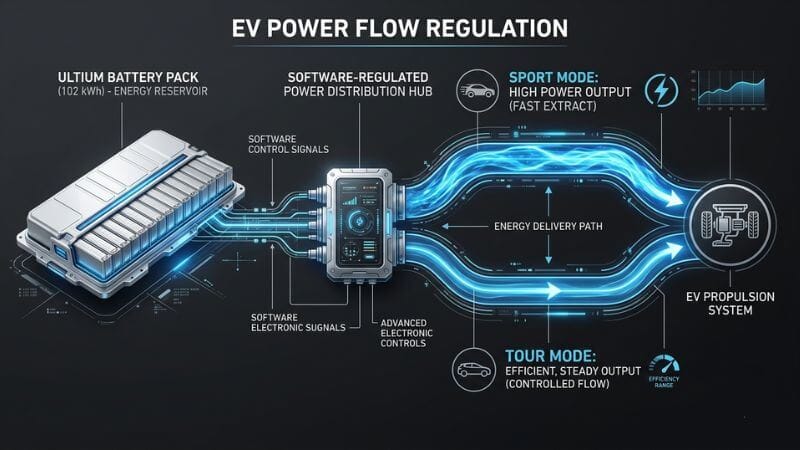
The Lyriq comes with a large battery pack. No driving mode makes that battery bigger or smaller. What changes is how quickly the car uses the energy stored inside it. A mode that uses energy more slowly can help the car travel further. A mode that uses energy faster may shorten how far you go.
In simple words: the battery stays the same. The driving mode changes how the car treats it.
Most drivers will notice a difference mainly in city driving and harder acceleration. In calm highway driving, the gap between modes is smaller and sometimes hard to feel at all.
What driving modes do not do: Driving modes do not change the size of the battery. They do not make the car dramatically more efficient on their own. They also do not override speed, weather, or how much heating or cooling the cabin needs. Those things still matter more than the mode you pick.
How Much Range Difference Do Driving Modes Actually Cause?
Realistic Range Change Between Modes
Many drivers notice a drop in range when switching from Tour Mode to Sport Mode. How big that drop is depends more on how you press the pedal than on the mode itself.
If you use Sport Mode in a calm way, the drop is small. If you push hard at every light, the drop is larger. The mode changes what is possible. Your driving style decides how much of that you actually use.
On city streets, the difference between Tour and Sport is easier to feel. You stop and start more often, and hard launches use more battery each time. On the highway at a steady pace, the gap between modes tends to be much smaller because the pedal is barely being used.
What Usually Causes the Biggest Range Loss
Speed is usually the top cause. The faster you drive, the more energy the car uses in every mode.
Weather comes second. Cold air can slow the battery down. High heat can make the cooling system work harder.
Heating and cooling the cabin come third. Running the heater in winter pulls energy from the battery before the car even moves.
In most cases, driving mode has less effect on range than speed, weather, or cabin comfort settings.
Will I Actually Notice the Difference Between Modes?
For most drivers, yes — but mainly in specific situations.
You will notice it most when accelerating hard from a stop in city traffic. On a calm highway drive with cruise control on, the difference can become very small.
How Each Cadillac Lyriq Drive Mode Affects Your Battery
Here is a quick comparison before going into each mode in detail.
| Feature | Tour Mode | Sport Mode | Snow/Ice Mode | My Mode |
|---|---|---|---|---|
| Pedal feel | Gentle and smooth | Sharp and quick | Very gentle | You set it |
| Best use | Daily range | Fun driving | Slippery roads | Custom setup |
| Energy use | Lower | Higher when pushed | Similar to Tour | Depends on settings |
| Range effect | Best baseline | May drop with hard use | Similar to Tour | Near Tour if set well |
| Safety grip | Standard | Standard | Extra grip help | Depends on settings |
Tour Mode — Everyday Travel and Best Range
Tour Mode is the Lyriq’s standard setting. It is not an Eco Mode. The Lyriq does not have an Eco Mode. Tour Mode is a good all-round option for everyday driving — gentle on the battery and easy to live with.
In Tour Mode, the car reacts smoothly when you press the pedal. Power comes in gradually. There are no sharp or sudden pulls on the battery.
For most drivers on most days, Tour Mode gives the best chance of getting real-world range close to what Cadillac advertises for range — depending on weather, wheel size, speed, and trim level.
Sport Mode — Quick Response and More Energy Use
Sport Mode changes how the car reacts to the pedal. A gentle press now asks the car for much more than the same press in Tour Mode.
Think of it this way. In Tour Mode, a soft press gives you a calm, steady push forward. In Sport Mode, that same soft press can bring a much bigger response. That uses more battery energy.
If you use that extra response often — hard launches, quick bursts of speed — your range may drop more. If you drive calmly in Sport Mode, the difference compared to Tour Mode is likely much smaller.
Sport Mode does not drain the battery faster on its own. It only costs more energy when you actively use the sharper response it provides.
Snow and Ice Mode — Safe Grip on Slippery Roads
Snow/Ice Mode is not designed for range. It is designed for safety.
This mode limits how much force reaches the wheels at once. On ice or snow, too much force causes the wheels to spin and slide. Snow/Ice Mode keeps that force gentle so the tires can hold the road.
Cold weather does lower your range, but Snow/Ice Mode is not the reason. The cold air itself affects how the battery works, regardless of which mode you pick.
My Mode — Your Own Custom Setup
My Mode lets you mix features from the other modes on your own terms.
Many drivers find a useful combination: Tour-style power delivery with Sport-style steering feel. The car still uses energy in a calm, controlled way, but the steering feels firmer and more responsive. You get an engaging drive without the full energy cost of Sport Mode.
It helps to understand what each setting actually changes. Steering feel changes how the car handles, not how much battery it uses. Power response affects energy use more directly. That is why Tour-style power with Sport-style steering can be a smart everyday mix — you keep efficiency where it matters most.
You build this setup through the 33-inch display screen. Steering weight, brake feel, and pedal response can each be changed on their own. They do not all have to match.
The Truth About AWD and the Front Motor
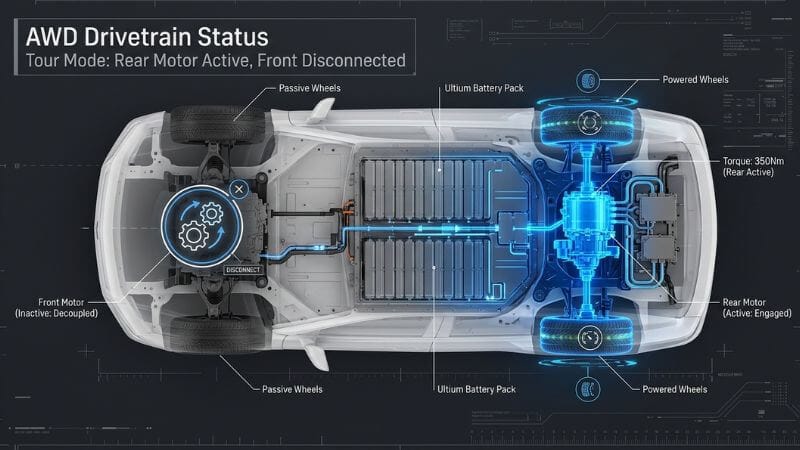
The Lyriq comes in two versions. The rear-wheel drive model has one motor. The all-wheel drive model has two — one at the front and one at the rear.
Two motors typically uses more energy than one. But Cadillac built a system that may help manage this in some driving conditions.
Under certain highway conditions in Tour Mode, the Lyriq AWD may reduce how much the front motor is working. When this happens, the car runs mainly on the rear motor. This can help lower energy use because the front motor is not being asked to contribute as much.
This may be one reason some AWD Lyriq owners notice better highway range in Tour Mode than they expected. Exact behavior can depend on speed, driving conditions, and trim level. It does not happen at all times or under all conditions.
In Sport Mode, the system may keep both motors more ready to respond. This can mean the car uses a little more energy during steady highway driving compared to Tour Mode.
If you own the AWD Lyriq and want better highway range, Tour Mode may allow the system to ease the front motor’s load in the right conditions — though exact behavior depends on speed and trim.
How Cruise Control and Super Cruise Affect Mode Impact
When you turn on cruise control or Super Cruise, the car’s computer takes over the accelerator. Your foot no longer decides how much power is used.
This matters because a big part of what makes Sport Mode use more energy is how a human foot presses the sharper pedal — quick bursts, uneven speed, sudden pushes. When the computer controls the throttle, it holds a smooth, steady pace regardless of which mode is active.
On steady highway drives, cruise control can reduce the energy gap between modes. This does not erase the difference, but it can make it smaller. Speed and road conditions still affect your range more than the mode does.
This is worth knowing on long highway trips. The mode matters less once the car is managing speed on its own.
Highway Speed Affects Range More Than Any Drive Mode
Many Lyriq owners think Sport Mode is the main reason for highway range drops. But speed is usually the bigger factor.
As you drive faster, air pushes back harder against the car. This force grows quickly at higher speeds and can become one of the largest costs to your range at highway pace — often larger than the difference between driving modes in many situations.
As a general guide, moving from a moderate highway speed to a faster one can cost more range than switching between Tour and Sport at a calm, steady cruise. This will vary based on conditions, but speed tends to be a larger factor than mode choice.
Wheel size plays a role too. The Lyriq is available with 20-inch and 22-inch wheels. Larger wheels are heavier and can create more resistance on the road. Owners with larger wheels may notice a range difference compared to the base smaller wheels, even when driving in exactly the same way.
Practical advice: For better highway range, easing back on speed a little and choosing the smaller wheel size tend to make more difference than changing your driving mode.
Real-World Energy Factors That Matter More Than Drive Modes
Cabin Heating, Seat Warmers, and Pre-Conditioning
Electric cars use battery energy to heat the cabin. There is no engine warmth to borrow from, as there would be in a petrol car. In winter, running the heater can pull meaningful energy from the battery before the car has moved an inch.
Seat warmers and steering wheel heaters warm you directly instead of heating all the air in the car. On cold days, using seat warmers rather than turning up the cabin heater can help protect your range.
Warming the battery while still plugged in at home can also help. A battery at a better temperature tends to work more effectively in cold conditions.
Temperature and the Battery
The Lyriq’s battery works best at moderate temperatures. Cold weather can slow down the process inside the battery cells, reducing how much energy they can give and how well they take in a charge.
Hot weather brings a different challenge. The system that keeps the battery cool has to work harder, and that also uses energy.
Neither of these is caused by your driving mode. They happen regardless of which mode you pick.
Hills, Weight, and Passengers
Going uphill uses more energy. Extra weight — passengers, luggage, cargo — adds to the cost of every climb. A fully loaded Lyriq will use more energy than an empty one, in any mode.
When Does Your Drive Mode Actually Matter Most?
Drive modes have the most noticeable effect in these situations:
- City driving with frequent stops: Hard launches in Sport Mode use more energy each time. Tour Mode handles this more gently.
- Hard acceleration: Sport Mode responds more sharply, which costs more battery when used that way.
- Winter roads: Snow/Ice Mode helps with grip on slippery surfaces, though cold weather still affects range on its own.
- Long highway trips with cruise control: The mode gap becomes smaller. Speed and road conditions take over.
Why Your Cadillac Lyriq Range Estimate Keeps Changing
Many owners get worried when the range number on the dashboard moves up and down. This is normal.
The range estimate changes based on recent driving. After a fast or aggressive drive, the number may drop. After calmer driving, it may rise again. Some EV drivers call this the “Guess-O-Meter” — because the number is a prediction, not a fixed count of what is left in the battery.
Why the Number Drops Overnight
Sometimes owners check before bed and find a lower number in the morning.
Cold temperatures can lower how much the battery is able to give at that moment. If the weather dropped overnight, the estimate may fall to reflect that.
The car also runs small background tasks while parked — keeping the battery at a safe temperature, checking for updates, staying connected. This quiet draw is small but can add up over a full night.
None of this means the battery is damaged. The car is doing what it is built to do.
How One-Pedal Driving and Regen Help Your Range
Regenerative braking is one of the most practical tools in the Lyriq. It works in every mode.
When you lift your foot off the accelerator, the motor changes what it is doing. Instead of moving the car forward, it helps slow the car down. That slowing motion creates some electricity, which goes back into the battery.
Regen helps recover some energy that would otherwise be lost during slowing. It cannot recover all the energy used, and it works best in city driving where you slow down often. On steady highway cruises, there is almost no chance to use it.
One-Pedal Driving Set to High
When set to High, lifting your foot creates firm slowing without touching the brake pedal. At the same time, energy goes back into the battery.
In city driving, where you stop and start often, this adds up across a whole trip. It is one of the simplest habits that can help improve range in everyday use.
The Regen Paddle on the Steering Wheel
There is a paddle on the left side of the steering wheel. Pulling it creates extra slowing on demand — useful when approaching a stop or slowing for traffic ahead.
Using this instead of the brake pedal keeps the physical brakes cooler and sends some energy back to the battery rather than losing it as heat.
Why Regen Is Less Useful on Highways
On the highway, you cruise at a steady pace and rarely slow down sharply. There is almost no opportunity to recover energy through regen in that kind of driving.
This is one reason city driving often gives better real-world range than highway driving in an electric car. The city gives many chances to recover small amounts of energy. The highway gives almost none.
Can Software Updates Change Your Range or Driving Feel?
Yes, in some cases they can — and many owners do not know this.
The Lyriq can receive updates through its internet connection, similar to how a phone gets updates. No trip to a dealer is needed for this.
Some updates may change how the pedal responds in different modes. After an update, Tour Mode might feel slightly different at low speeds. Sport Mode might respond a little differently when pulling away. Not every update affects this, but it does happen.
Some updates can also change the way range is estimated. You may notice a slightly different number even with the same battery level as before the update.
To check for updates, open the main menu on the 33-inch display and look under settings for software or system updates. The car will usually also let you know when one is available.
Not every update changes how the car drives. But knowing this is possible can help you understand why the car may feel slightly different after a routine update.
Also Read: 35 High‑Paying Messy Jobs You Can Start in 2026 — Real Costs, Training, and Safety
How to Set Up My Mode for Daily Driving
My Mode is the most practical setting for everyday use. Here is how to set it up for a good mix of range and driving feel.
Step 1: On the 33-inch display, tap the drive mode button or go into driving modes settings.
Step 2: Select My Mode.
Step 3: Set powertrain response to Tour. This keeps the car’s power delivery gentle and easy on the battery.
Step 4: Set steering weight to Sport. This gives firmer steering feel without the full energy cost of Sport Mode.
Step 5: Set one-pedal driving to High to recover more energy in city traffic.
Step 6: Leave brake feel at default unless you want to change it.
Step 7: Save the setting.
Remember: steering weight changes how the car feels to steer, not how much battery it uses. Power response is what affects energy use more directly. Keeping power on Tour while using Sport steering gives you a smarter everyday balance.
Quick checklist for best daily range:
- My Mode with Tour power response
- One-pedal driving set to High
- Highway speed kept moderate where possible
- Cabin warmed or cooled while still plugged in at home
- Regen paddle used when slowing instead of the brake
Frequently Asked Questions About Cadillac Lyriq Drive Modes
Why does my Cadillac Lyriq range drop overnight?
Cold temperatures can lower how much the battery is able to give at that moment, and the car runs small background tasks while parked. Both can bring the range estimate down by morning. This is normal and does not mean anything is wrong with the battery.
Is Sport Mode bad for long highway trips?
Not necessarily. Once cruise control or Super Cruise is active, the energy gap between Sport Mode and Tour Mode often becomes smaller. On long highway drives, your speed tends to matter more than which mode you picked.
Why does regen braking feel weaker in cold winter weather?
Cold batteries may take in energy more slowly. In very cold conditions, the car may limit how quickly energy returns to the battery during slowing. Regen may feel softer until the battery warms up to a better working temperature.
Does DC fast charging affect long-term battery range?
Occasional DC fast charging is generally considered fine for the Ultium pack, which has a thermal management system built in. Relying on fast charging every single day instead of home charging may add more heat cycles over time, but occasional use is not a concern for most owners.
Can a software update improve my Lyriq’s real-world efficiency?
In some cases, yes. Some updates have changed how the pedal responds or how range is estimated. Not every update affects efficiency, but it is possible for improvements to arrive through software without a dealer visit.
Why is my highway range lower than my city range?
At highway speeds, air resistance becomes a major energy cost, and there is almost no chance to recover energy through regen at a steady cruise. City driving gets many small energy recoveries that add up meaningfully over a trip.
Does cabin heat drain the Lyriq battery faster than AC?
In most cases, yes. Heating the cabin typically uses more energy than cooling it. Pre-conditioning the cabin while still plugged in at home is the most practical way to reduce this drain during the drive.
Does charging to 100% affect my displayed range estimate?
Charging to 100% shows the highest possible range estimate. But that number is still based on your recent driving history. If you charged to 100% after a fast or aggressive drive, the estimate may read lower than expected — even at a full charge.
Final Answer — Which Cadillac Lyriq Mode Is Best for Your Drive?
Tour Mode works best for daily driving. It keeps power delivery gentle and gives you a good chance at range close to what Cadillac advertises — depending on weather, speed, and wheel size.
Sport Mode is best when range is not the main focus. On long highway trips with cruise control or Super Cruise active, the energy gap between Sport and Tour often becomes much smaller.
Snow/Ice Mode is for safety on slippery roads. Cold weather lowers your range on its own — this mode is there to keep you in control.
My Mode is the smartest everyday setup for most owners. Set it with Tour power response and Sport steering feel for a practical daily balance.
Speed, weather, and driving habits shape your range more than any mode. Use Tour or My Mode daily, keep your highway speed moderate, and use the regen paddle when slowing down.
You May Also Like: Falkirk Pavement Parking Ban: £100 Fines, Exempt Streets, Rules & How to Avoid Penalties
Disclaimer:
The information provided in this guide is for educational purposes to help owners understand general vehicle behavior. Real-world electric vehicle performance, battery capacity, and efficiency metrics can vary based on individual driving habits, ambient weather conditions, software versions, and specific vehicle configurations. Some illustrations, diagrams, and visual aids on this page may be generated using AI technologies to assist with conceptual clarity and scannability; they are intended strictly for user reference and should not replace formal vehicle documentation or professional dealer advice.

Hi, I’m Emma Rose, the creative founder of Punstation.com. With a background in crafting hundreds of engaging guides and clever wordplay, I specialize in making complex information easy and fun to digest. Whether I’m exploring technical trends, lifestyle ideas, or creating my signature witty puns, my goal is to provide useful, well-researched content that helps solve problems and brings a smile to your face. For me, every topic, from tech to humor, is an opportunity to share clear, practical insights with a fresh perspective.