
Last Updated: 10/September/2026
A good pun combines two recognizable meanings, sounds, or interpretations, a meaningful connection between them, natural context, and a surprising twist. Strong puns are usually clear, concise, and appropriate for their audience. Most importantly, the two meanings must work together; simply finding a word with two meanings does not automatically create a good pun.
For example, consider: “I lost interest in banking.”
The word interest has more than one meaning. It can mean money earned from a bank account, but it can also mean curiosity or enthusiasm. Both meanings fit the sentence, and the second one creates the twist.
So, what makes a good pun? In simple terms, it needs clear wordplay, two plausible interpretations, a meaningful connection, surprise, natural context, brevity, and a good fit for the audience.
But there is an important point: two meanings alone do not make a good pun. The meanings have to work together. That is where clever wordplay becomes a real joke.
What Makes a Good Pun?
A strong pun usually has seven key elements.
1. Two Plausible Meanings
A pun often begins with a word, phrase, or sound that can be understood in two different ways.
Take interest. It can refer to financial interest or something that attracts your attention. That gives a writer two meanings to work with.
But simply finding a word with two meanings is not enough.
For example:
“I went to the bank near the river.”
The word bank can refer to a financial institution or the side of a river. There is potential ambiguity here, but there is no real joke.
A good pun activates both meanings in a way that creates an interesting result.
“I lost interest in banking.”
Now the two meanings of interest work together inside one sentence. The first meaning fits the banking context, while the second gives the sentence its unexpected twist.
2. A Meaningful Connection
This is one of the most important parts of a good pun.
The two meanings should not feel like random words thrown together. They should have some connection to the situation in the joke.
Think of a good pun as two ideas meeting in the same sentence.
A good pun doesn’t simply place two meanings next to each other. It makes them collide inside the same situation.
That connection is what makes the wordplay feel satisfying rather than forced.
For example:
“I wanted to learn more about electricity, but the subject wasn’t my current interest.”
Here, current works naturally because it relates to electricity and can also describe something happening now. The surrounding sentence gives both meanings a reason to be there.
3. Surprise
A pun needs a small turn.
The reader usually starts with one expected meaning and then discovers another. That quick change creates the classic “Oh, I get it” moment.
Consider:
“I wondered why the baseball was getting bigger. Then it hit me.”
At first, hit me sounds like an expression meaning “I suddenly understood.” The baseball context then gives it a literal meaning: the ball actually hit the speaker.
The surprise does not come from using a difficult word. It comes from changing how we understand a familiar phrase.
4. Natural Context
Context gives a pun its setup.
A word may have two meanings, but the joke works better when the sentence naturally prepares us for both.
Compare these:
Forced:
“I am talking about time because thyme sounds like time, so here is my gardening joke.”
Natural:
“My garden is growing on me. I just need to give it some thyme.”
The second version does not stop to explain the wordplay. The gardening context makes thyme feel like a natural part of the sentence while the sound points toward time.
A strong pun should feel as if the sentence was written for the wordplay—not as if the wordplay was squeezed into an unrelated sentence.
5. Brevity
Puns usually benefit from being short.
The longer the setup becomes, the more likely the reader is to predict the punchline or lose interest before reaching it.
Compare:
“I was thinking about making a joke about gardening, and then I remembered that the word thyme sounds like time, so I decided to say that I would give the garden some thyme.”
That is far too much setup.
A cleaner version is:
“I need to give my garden some thyme.”
The idea arrives quickly, and the reader can spot the second meaning without digging through unnecessary words.
Brevity does not mean every pun must be only a few words. It means every word should help the setup, meaning, or punchline.
6. Clarity
A clever pun should not be so complicated that the reader cannot tell what is happening.
This does not mean every pun needs to be obvious. A little delay can make the joke more satisfying. But there is a difference between surprise and confusion.
A good pun makes the reader think:
“Oh! That makes sense.”
A weak pun often makes the reader think:
“What does that mean?”
If the second meaning only becomes clear after a long explanation, the wording may need work.
7. Audience Fit
A good pun for one audience may be a terrible pun for another.
A joke about a complicated scientific term might work beautifully for science students but fall flat with a general audience. A simple food pun might be perfect for a social media caption but feel too basic in a linguistics lecture.
The best pun matches the people who will read or hear it.
Ask yourself:
- Will they know the word or reference?
- Will they recognize both meanings?
- Is the level of wordplay right for them?
- Does the subject matter make sense in their context?
A good pun is audience-relative. Complexity is not automatically bad, and simplicity is not automatically good. The real question is whether the audience can enjoy the wordplay.
The Most Important Rule: Ambiguity Isn’t Enough
Here is the easiest way to understand what separates a pun from ordinary ambiguity:
Ambiguity ≠ comedy.
A word can have two meanings without being funny.
For example, bank can mean a financial institution or the edge of a river. That gives us two meanings, but this sentence is not a joke:
“The bank is beside the river bank.”
Both meanings are present, but there is no real surprise or clever connection.
A pun uses that ambiguity for a purpose.
A useful way to think about it is:
One word with two meanings → ambiguity
Two meanings used together for effect → wordplay
Two meanings that connect naturally and create a twist → a stronger pun
This is why simply searching a dictionary for words with multiple meanings does not automatically produce good jokes.
The real skill is finding a situation where both meanings belong.
Good Pun vs. Bad Pun
Not every technically correct pun works.
| Example | Result | Why |
|---|---|---|
| “I lost interest in banking.” | Good | Both meanings of “interest” fit naturally. |
| A random homophone inserted into an unrelated sentence | Weak | Sound similarity alone is not enough. |
| A joke that needs a long explanation | Weak | The wording may be hiding the punchline. |
| A highly technical reference for a general audience | Audience-dependent | It may work if readers know the reference. |
| A short joke where both meanings fit the same situation | Strong | The setup and wordplay support each other. |
A useful rule is simple:
Don’t ask only, “Does this word have two meanings?” Ask, “Do both meanings belong here?”
That second question is where much of the real craft lies.
Good Pun vs. Great Pun
A good pun usually has:
- Two recognizable meanings or sounds
- A clear connection
- A logical setup
- A noticeable twist
- Enough clarity to understand the joke
A great pun takes those ideas one step further.
It makes both meanings feel almost inevitable once you hear the punchline. The context prepares you for the word, but you do not notice the second interpretation until the right moment.
A great pun is also economical. It does not need five sentences to explain a three-second joke.
Most importantly, it creates surprise without confusion.
That is the sweet spot:
You understand it quickly, but you don’t see it coming.
For example, consider this visual pun:

“Just a typical pound cake workin’ on its crust.”
Why it works: The image treats a pound cake as if it were a person working out. The contrast between a cake and a fitness routine creates an unexpected interpretation, while “crust” keeps the joke connected to the cake itself.
This shows how a stronger pun can combine wordplay, context, and visual surprise rather than relying on a double meaning alone.
Types of Wordplay That Create Puns
Puns can be built in several different ways. The mechanism changes, but the basic goal stays the same: create an interesting relationship between meanings, sounds, or interpretations.
Homophones
Homophones are words that sound the same but have different meanings or spellings.
For example:
sole / soul
A pun can use the sound of one word to make the reader think of the other.
This is common in short jokes, captions, and one-liners because the switch can happen very quickly.
Multiple Meanings
Some puns use one word that has different meanings.
“I lost interest in banking.”
Here, interest has a financial meaning and a more general meaning related to attention or enthusiasm.
The same word carries both sides of the joke.
Idiom-Based Puns
Familiar expressions can be especially useful because readers already know the expected meaning.
For example:
“I wondered why the baseball was getting bigger. Then it hit me.”
The phrase hit me normally means that someone suddenly understood something. The baseball creates a second, literal interpretation.
Phrase Ambiguity
Sometimes the wordplay comes from a phrase that can be interpreted in more than one way.
“I’m reading a book about anti-gravity. It’s impossible to put down.”
The phrase put down can refer to placing something somewhere, while the reading context suggests stopping or setting aside the book.
The first sentence establishes the gravity idea. The second sentence then makes the familiar phrase work in a different way.
Visual Puns
Puns do not always have to be spoken or written.
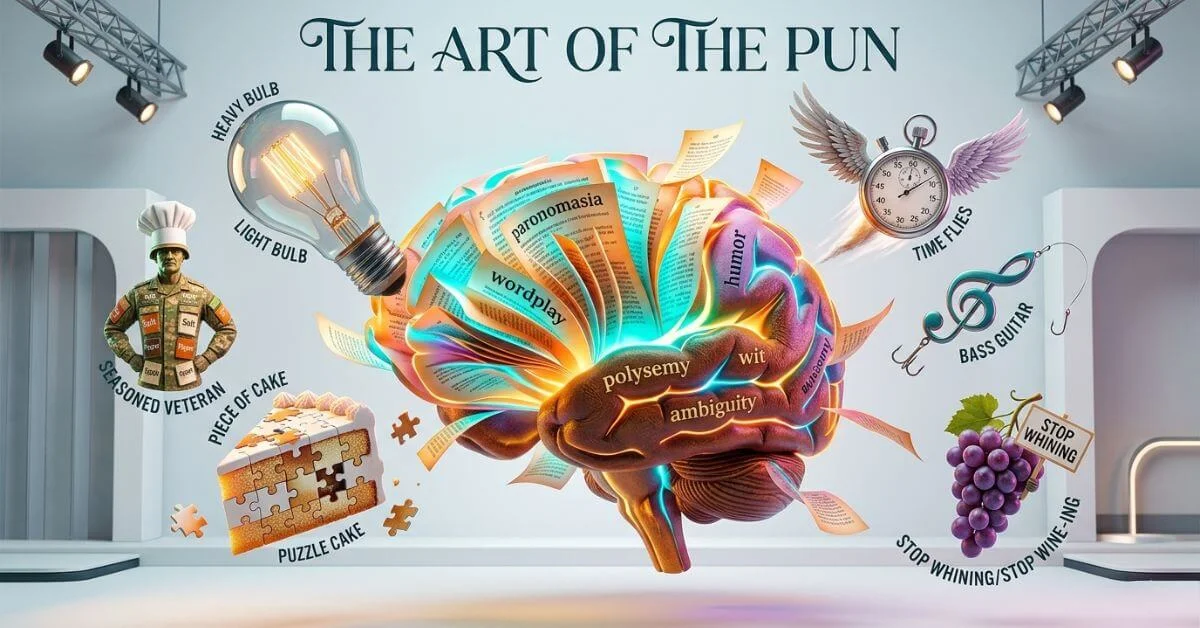
A visual pun can take an expression or word literally and show it in an image. For example, an artist might literally show “time flies” by drawing a clock with wings.

Why it works: The phrase “seasoned veteran” combines seasoned in the sense of experienced with seasoned in the culinary sense of adding spices. The image makes both meanings visible at the same time.
The same basic principle applies: the audience recognizes one meaning and then sees another interpretation at the same time.
Visual puns can be especially effective because the image can deliver the twist instantly.
Five Examples of Good Puns—and Why They Work
Looking at the mechanics makes it easier to see why certain puns work.
Example 1: Anti-Gravity
“I’m reading a book about anti-gravity. It’s impossible to put down.”
Mechanism: Idiomatic phrase + literal interpretation
Meaning 1: “Put down” can mean to place something down.
Meaning 2: In a reading context, it can mean stopping or setting aside a book.
Why it works: The anti-gravity setup makes “put down” sound literal, while “I’m reading a book” activates the familiar expression “put a book down,” meaning to stop reading or set it aside.
Example 2: Two-Tired Bicycle
“A bicycle can’t stand on its own because it is two-tired.”
Mechanism: Homophonic wordplay
Sound: “Two-tired” / “too tired”
Expected phrase: “Too tired”
Twist: “Two-tired”
Why it works: A bicycle naturally has two tires, while “too tired” is the phrase the reader expects. The change is small, quick, and easy to understand.
Example 3: Banking Interest
“I lost interest in banking.”
Mechanism: Multiple meanings
Meaning 1: Financial interest
Meaning 2: Personal interest or enthusiasm
Why it works: Banking makes the financial meaning feel natural. The ending shifts the reader toward the everyday meaning of interest.
Example 4: Baseball
“I wondered why the baseball was getting bigger. Then it hit me.”
Mechanism: Idiom + literal meaning
Meaning 1: “It hit me” means “I suddenly understood.”
Meaning 2: A baseball can literally hit someone.
Why it works: The first sentence creates a mystery. The second sentence solves it while changing the meaning of a familiar expression.
Example 5: Garden Thyme
“I need to give my garden some thyme.”
Mechanism: Homophone
Sound: “Thyme” / “time”
Meaning 1: Thyme is an herb.
Meaning 2: Time is something you give or spend.
Why it works: It sounds like “give my garden some time,” while thyme is an herb associated with the gardening context.
Why Some Puns Feel Forced
If a pun feels awkward, the problem is often not the wordplay itself. The sentence around it may be doing too much work.
A forced pun often has one or more of these problems:
1. The sentence exists only to deliver the pun
If the entire sentence sounds unnatural before the punchline, readers may notice the trick too early.
2. The second meaning does not fit
A word can have two meanings, but if one meaning has nothing to do with the situation, the joke can feel random.
3. The setup is too long
Too much explanation can bury the punchline.
4. The reference is too obscure
If readers do not understand the reference, they cannot enjoy the wordplay.
5. The wording sounds unnatural
A pun should not force people to speak or read in a way they normally would not.
6. The punchline is too predictable
Surprise matters. If the second meaning is obvious from the first few words, the effect can be weaker.
A useful editing question is:
Would I write this sentence if the pun were removed?
If the answer is no, look closely at the wording. The sentence may have been built around the pun instead of the idea.
How to Write a Good Pun in 6 Steps
You do not need to be a professional comedian to make a decent pun. Start with a simple process.
Step 1: Start With a Topic
Pick something specific.
For example:
Gardening
Step 2: Build a Word Bank
Write down words connected to the topic:
- Plant
- Root
- Leaf
- Soil
- Grow
- Thyme
- Flower
Step 3: Find a Second Meaning
Look for words that can connect to another idea.
Thyme → time
Now you have a possible wordplay connection.
Step 4: Find a Situation That Fits Both Meanings
Do not force the word into a random sentence.
Think about situations involving gardens, plants, waiting, patience, schedules, or time.
Step 5: Write the Shortest Natural Version
For example:
“I need to give my garden some thyme.”
The sentence works because the gardening context supports thyme, while the sound creates the second meaning.
Step 6: Cut Anything Unnecessary
Read the joke again.
Can you remove a word without losing the setup or meaning?
If yes, remove it.
A good pun often gets better when the sentence gets tighter.
Want the complete beginner-friendly process? See our How to Write Puns Step by Step guide for a more detailed walkthrough.ntence gets tighter.
The 10-Point Pun Quality Test
Want a quick way to judge your own pun?
Give it 0, 1, or 2 points in each category.
| Test | 0 Points | 1 Point | 2 Points |
|---|---|---|---|
| Double meaning | None | Weak | Clear |
| Context | Forced | Somewhat natural | Perfect fit |
| Connection | Random | Understandable | Meaningful |
| Surprise | Predictable | Mild | Strong |
| Clarity | Confusing | Understandable | Instant |
Your score
9–10: Excellent pun
7–8: Good pun
5–6: Needs polishing
0–4: Probably forced
This is not a scientific measurement. It is simply a practical editing tool.
If your pun scores low, look at the weakest category first. A great word with poor context can often be fixed by changing the sentence around it.
The 5-Second Pun Test
Here is an even faster test.
Ask:
Can your intended reader understand the second meaning within a few seconds without needing a long explanation?
If yes, the pun probably has a solid foundation.
If no, look at the wording, context, or audience.
Remember that this is not an absolute rule. Some literary, educational, or highly specialized puns are meant to take longer to understand. The goal is not to make every pun obvious. The goal is to make the eventual connection satisfying.
Why Do Puns Make Us Laugh—or Groan?
One reason puns can feel satisfying is that the reader first interprets a word or phrase one way and then recognizes another meaning.
That creates a small mental shift:
Expected meaning → surprise → second meaning → “Oh!”
This is closely related to the idea of incongruity, one major approach used to explain humor. Incongruity describes the amusement that can arise when an expectation is disrupted in a way the audience can still understand.
That last part matters.
If the surprise makes sense, it can feel clever. If it makes no sense, it simply feels confusing.
And sometimes the reaction to a good pun is not laughter at all.
It is a groan.
That does not necessarily mean the pun failed. Some puns are funny precisely because they are so obvious, silly, or delightfully terrible.
A useful way to think about pun quality is:
Cleverness + surprise + groanability
A pun can be clever and funny, clever but groan-worthy, or silly but memorable.
Can a Pun Be Good Without Being Funny?
Yes.
“Funny” is not the only possible goal of wordplay.
A pun can be:
- Clever
- Playful
- Memorable
- Cute
- Surprising
- Groan-worthy
- Thought-provoking
For example, a pun in an advertising slogan may be designed to make a brand memorable rather than produce a big laugh.
A literary pun may add a second layer of meaning to a sentence.
A children’s pun may be intentionally simple.
So a good pun should be judged by what it is trying to achieve—not only by whether everyone laughs.
Puns in Literature and Everyday Communication
Puns have been used in literature, conversation, advertising, headlines, names, captions, and everyday jokes for a very long time.
Writers use them because one word can sometimes carry several ideas at once. A well-placed pun can add humor, create a memorable phrase, or give a sentence an extra layer of meaning.
William Shakespeare, for example, frequently used wordplay in his writing. His use of puns shows that wordplay is not limited to modern one-liners or “dad jokes.”
But you do not need Shakespeare’s vocabulary to write a good pun.
The same principles work in everyday communication. A short pun in a text message, caption, birthday card, or conversation can be effective when the wordplay fits the moment.
The key is not how impressive the word sounds.
It is how well the meanings work together.
Frequently Asked Questions
What makes a pun good?
A good pun usually combines two plausible meanings or sounds with a clear connection, natural context, surprise, and concise wording. It should be understandable to its intended audience without creating unnecessary confusion.
What are the seven elements of a good pun?
The seven main elements are two plausible meanings, a meaningful connection, surprise, natural context, brevity, clarity, and audience fit. Not every pun needs each element in exactly the same way, but these provide a useful framework for judging wordplay.
Does a pun need to be funny?
Not always. A pun can be clever, playful, memorable, or deliberately groan-worthy. What matters is that the wordplay creates a useful or enjoyable effect for its intended audience.
What makes a pun bad?
A pun may fail when the second meaning does not fit the context, the wording feels forced, the setup is too long, the reference is too obscure, or the punchline is confusing or predictable.
What is the difference between a good pun and a bad pun?
A good pun makes its different meanings work together naturally and gives the reader a clear twist. A bad pun may technically contain wordplay but feel random, forced, confusing, or unrelated to the surrounding sentence.
Can a pun have more than two meanings?
Yes. A sentence can play with several meanings at once. However, adding more meanings does not automatically make a pun better. If extra layers make the joke difficult to follow, they can weaken the result.
Are puns always based on homophones?
No. Puns can use homophones, multiple meanings, idioms, ambiguous phrases, similar sounds, or visual interpretations. Homophones are just one common way to create wordplay.
How do you make a pun less forced?
Start with a natural sentence rather than forcing a word into it. Make sure both meanings fit the situation, remove unnecessary setup, and read the sentence aloud. If the wording sounds unnatural, revise the sentence before worrying about the punchline.
Why do some puns make people groan?
Puns often create a predictable type of wordplay that is intentionally silly. The groan can be part of the fun, especially when the reader understands the joke immediately but still appreciates the clever connection.
What is the easiest way to create a pun?
Pick a topic, make a list of related words, find one with another meaning or a similar-sounding word, and build a short sentence where both ideas fit naturally. Then remove any unnecessary words.
Final Thoughts
So, what makes a good pun?
It is more than finding a word with two meanings.
The strongest puns make two ideas fit the same situation, then use timing and surprise to make the reader notice the second meaning at just the right moment. They are clear without being predictable, clever without being complicated, and short without feeling incomplete.
When you’re writing your next pun, start with one simple question:
Can these two meanings naturally belong in the same sentence?
If the answer is yes, you may have a strong pun. And if it earns a groan along the way, that’s part of the fun.

Hi, I’m Emma Rose, the creative founder of Punstation.com. With a background in crafting hundreds of engaging guides and clever wordplay, I specialize in making complex information easy and fun to digest. Whether I’m exploring technical trends, lifestyle ideas, or creating my signature witty puns, my goal is to provide useful, well-researched content that helps solve problems and brings a smile to your face. For me, every topic, from tech to humor, is an opportunity to share clear, practical insights with a fresh perspective.