
Last Updated: 28/May/2026
Stormuring is a waterproof mortar made in Norway. Its full name is Hey’di Stormuring. It has tiny fibers mixed inside the powder. These fibers stop cracks from spreading. The mortar keeps water out of walls, basements, and brick surfaces. You can use it indoors and outdoors. It dries fast enough to paint the next day.
Some websites say Stormuring is a weather term or a business word. That is wrong. Stormuring is only a building material sold by Hey’di, a Norwegian company. This guide covers real product facts, mixing steps, where to buy it, and how it compares to other mortars.
What Is Stormuring?
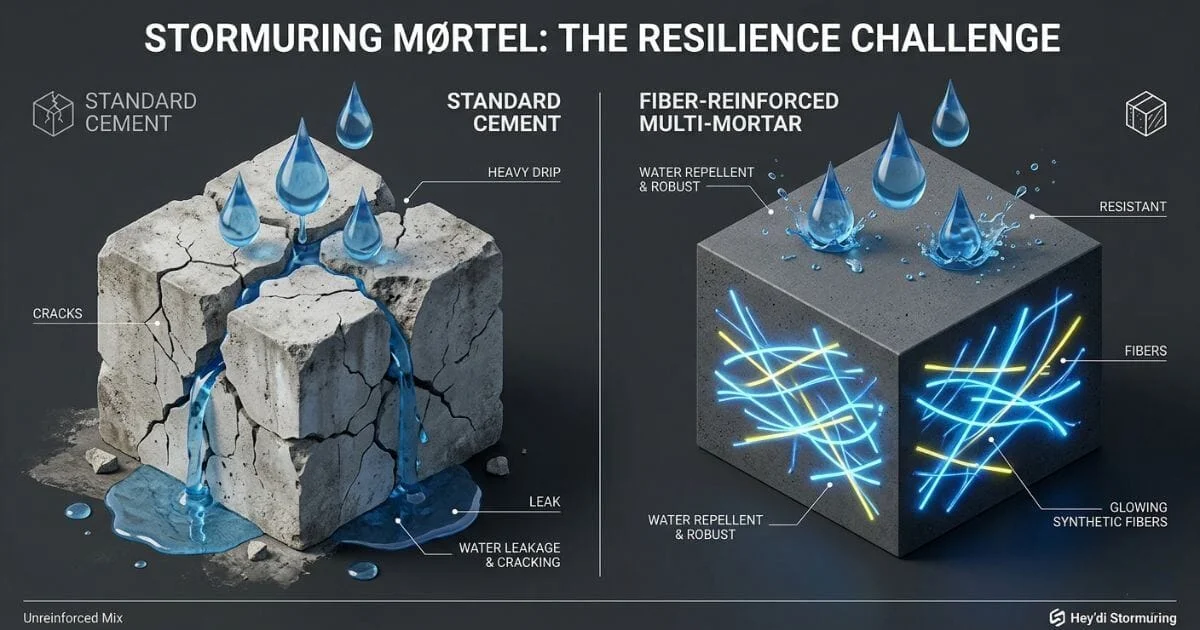
Stormuring is a dry mortar powder made from cement, sand, and tiny plastic fibers. You add water, mix it, and apply it to walls. The fibers spread through the mix and hold everything together. This stops small cracks from growing into big ones.
It resists water coming in from outside (rain) and from inside (wet soil pressing on a basement wall). Builders call these two directions positive and negative water pressure. Most regular mortars handle only one direction. Stormuring handles both.
| Detail | Value |
|---|---|
| Made by | Hey’di, Norway |
| Bag size | 15 kg |
| Main uses | Walls, basements, brick repair, bathrooms |
| Works indoors/outdoors | Yes, both |
| Handles both water pressures | Yes |
Real Stormuring vs. Common Myths
Three types of false content about Stormuring appear in search results. Each one comes from a low-quality website, not from any building or construction source.
Myth 1 — Weather term. Some pages claim Stormuring describes a storm weather pattern. No such weather term exists in meteorology or Norwegian weather science. Source of this claim: thebigger.com, a content-farm site.
Myth 2 — Business strategy. Other pages claim Stormuring is a business growth method. No corporate dictionary, MBA glossary, or business publisher uses this term. Source: quietfluence.com, an unverified blog.
Myth 3 — Stress-to-creativity concept. A third claim says Stormuring means turning stress into creative energy. No psychology journal, self-help publisher, or verified author uses this term. Source: nameoye.com, a content-farm site.
Fact: Stormuring is registered as a product by Hey’di AS, a Norwegian building materials company. It is sold in Norwegian hardware stores and listed on official retail websites with product codes, weight specs, and datasheets.
Hey’di Stormuring: Full Product Specs
These figures come directly from Hey’di’s official product documentation.
| Spec | Detail |
|---|---|
| Bag weight | 15 kg |
| Water per bag | 3 liters (exact — do not add more) |
| First mix time | 2 minutes with a drill mixer |
| Rest time | 5 minutes (required) |
| Second mix | 30 seconds |
| Working time after mix | 1 hour |
| Layer thickness | 8 mm minimum — 10 cm maximum per coat |
| Ready to paint | Next day |
| Minimum application temp | +6°C |
| Compatible surfaces | Brick, Leca block, concrete, masonry |
| Water pressure resistance | Positive and negative |
| Fiber reinforced | Yes |
One important rule: Do not add extra water if the mix feels stiff. Extra water weakens the final mortar and reduces waterproofing.

Where to Use Stormuring
1. Outside Walls
Stormuring forms a hard render on exterior walls. It blocks wind-driven rain and resists freeze-thaw cycles, which are common in Norway’s climate. One coat of 10 mm handles most residential exterior jobs.
2. Basements
Wet soil constantly pushes water inward against basement walls. This is negative water pressure. Stormuring resists this force from the inside surface, which most coatings cannot do. It suits both poured concrete and block-built basements.
3. Brick and Masonry Repair
Old mortar joints crack over time and let water in. Stormuring fills those joints and bonds tightly to existing brick. Its fiber content means the repaired section is less likely to crack again than standard repair mortar.
4. Bathrooms and Wet Rooms
Applied under tiles, Stormuring stops moisture from reaching the structural wall behind. This prevents mold growth in the wall cavity, which is a common problem when only tile adhesive is used.
5. Retaining Walls
Garden and structural retaining walls face constant soil moisture. Stormuring applied to the soil-side face adds waterproof protection and extends the life of the wall significantly.
6. Balconies
Rain pools on balconies and works through cracks into the floor below. A Stormuring base coat before the final floor finish creates a watertight barrier.
7. Heritage and Stone Buildings
Old stone walls need a mortar that is strong but not so rigid that it damages the original material. Stormuring is vapor-permeable, meaning the wall can still dry out naturally after rain. This prevents moisture from getting trapped behind the surface.
8. Flood Defense Work
In areas where flooding is a growing risk, Stormuring is used to upgrade older wall systems. It adds structural resistance without requiring full wall replacement.
How to Mix Stormuring
Tools required: 20-liter bucket, drill with paddle mixer, measuring jug, trowel, sponge float, safety gloves, eye protection.
Steps:
- Clean the wall. Remove loose mortar, dirt, dust, and paint flakes. The surface must be solid for the mortar to bond.
- Wet the surface. Spray clean water on the wall and wait for it to soak in fully. Do not apply to a bone-dry surface.
- Measure water first. Pour exactly 3 liters of clean water into the bucket before adding powder.
- Add the powder. Empty the 15 kg bag into the water, not the other way around.
- Mix for 2 minutes. Use a drill with a paddle attachment. Mix until the paste is smooth with no dry lumps.
- Rest for 5 minutes. Leave the bucket. This step allows the fibers and cement to fully activate. Skipping it reduces performance.
- Mix again for 30 seconds. The mix will be smooth and ready to use.
- Check consistency. The paste should hold its shape like thick peanut butter. If it flows, it is too wet and will be weaker.
- Apply within 1 hour. The mix hardens after 60 minutes at normal temperatures.
Temperature note: Do not apply if the air or surface temperature is below +6°C. Cold temperatures slow curing and can cause the mortar to fail.
How to Apply Stormuring
Step 1. Apply a thin scratch coat (bonding layer) to the damp wall. Press firmly with the trowel so it makes contact with the full surface.
Step 2. Wait 20 to 30 minutes for the scratch coat to set slightly — it should feel firm but not fully dry.
Step 3. Apply the main coat. Build up to your target thickness between 8 mm and 10 cm in a single pass.
Step 4. Push the mortar firmly into any open brick joints or cracks. Do not leave air pockets behind the surface.
Step 5. Smooth the surface with a sponge float using circular motions.
Step 6. Protect from hot sun and direct rain for the first 24 hours. In hot weather, lightly mist the surface with water once or twice during the first day to prevent surface drying too fast.
Step 7. Allow 1 to 2 days before applying paint, tiles, or any finish coat.

Stormuring vs. Normal Cement
| Feature | Stormuring | Normal Cement |
|---|---|---|
| Fibers | Yes — stops crack growth | No |
| Waterproof | Both sides, built in | Needs separate coating |
| Crack resistance | High | Low |
| Water pressure | Positive + negative | Positive only |
| Coats needed | One thick coat | Multiple thin coats |
| Ready to paint | Next day | 24–48 hours |
| Cost (15 kg) | ~200–250 NOK | Lower, but needs extra materials |
Normal cement is cheaper upfront. However, it requires a separate waterproof coating applied after curing, adding time and cost. Stormuring combines structural mortar and waterproofing in one material, which reduces total project time.
Stormuring vs. Other Waterproof Products
| Feature | Stormuring | Sika Monotop | Liquid Membrane |
|---|---|---|---|
| Product type | Dry mortar powder | Dry mortar powder | Liquid coating |
| Fiber reinforced | Yes | Some versions | No |
| Thickness per coat | 8 mm to 10 cm | 5–20 mm | 1–3 mm |
| Structural strength | High | High | Low (surface only) |
| Vapor permeable | Yes | Yes | No |
| DIY suitability | Yes | Yes | Yes (brush/roller) |
| Approx. price (15 kg) | ~200–250 NOK | ~300 NOK | ~400 NOK per 10 L |
Use Stormuring when you need a thick, load-bearing waterproof layer for walls, basements, or masonry repair.
Use liquid membrane when you need a very thin surface coat for an already-sound surface and do not need structural performance.
Where to Buy Hey’di Stormuring
Stormuring is sold exclusively in Norway and the Nordic region. No confirmed distribution exists in the United States, United Kingdom, Australia, or continental Europe through major retail chains.
Verified Norwegian retailers:
- Bauhaus Norway — bauhaus.no — ~200–250 NOK per 15 kg bag
- Maxbo — maxbo.no — 4.0/5 stars customer rating
- Byggmakker — byggmakker.no
- XL-BYGG — xl-bygg.no
- Monter.no — monter.no
Official manufacturer: heydi.no
Official product video: Hey’di AS on YouTube — mixing demonstration (4 minutes 56 seconds, 58,000+ views).
Not available at: Home Depot (USA), B&Q (UK), Bunnings (Australia), Leroy Merlin (EU), or any Alibaba seller. Products sold under the Stormuring name on international platforms are not verified Hey’di products.
7 Benefits of Using Stormuring
1. Stops cracks from spreading. The plastic fibers act like a mesh inside the mortar. When pressure forms, the fibers absorb it and keep small cracks from growing.
2. Waterproof on both sides. Rain cannot push through from outside, and groundwater cannot push through from inside. This dual resistance is what separates it from standard cement render.
3. Stronger than plain cement. Fibers add tensile strength, meaning the mortar resists pulling and bending forces that brittle cement cannot handle.
4. One product for multiple jobs. The same 15 kg bag works for exterior rendering, basement walls, bathroom waterproofing, and masonry repair. You do not need separate specialist products.
5. Fast turnaround. Apply it today and apply a paint or tile finish the next morning. Standard cement render usually needs 48 to 72 hours minimum.
6. Tested in cold, wet climates. Norway experiences harsh winters with repeated freeze-thaw cycles. Stormuring is designed and tested for these conditions, making it reliable in any cold-climate market.
7. Walls can breathe. Stormuring is vapor-permeable. Moisture trapped inside the wall structure can still escape, which prevents the hidden damp and mold growth that non-breathable coatings often cause.
5 Common Mistakes to Avoid
Mistake 1 — Adding too much water. More than 3 liters per 15 kg bag weakens both the bond strength and the waterproof performance. Measure the water before adding the powder.
Mistake 2 — Skipping the 5-minute rest. This rest period is part of the chemical activation, not just a suggestion. Missing it produces a mix that looks fine but performs below specification.
Mistake 3 — Applying too thin. Below 8 mm, the mortar does not have enough mass to resist water pressure reliably. Use a depth gauge or scratch marks on the trowel to check thickness.
Mistake 4 — Applying to a dirty surface. Oil, dust, loose paint, and old crumbling mortar all break the bond between Stormuring and the wall. Clean the surface thoroughly before wetting it.
Mistake 5 — No weather protection after application. Direct sun dries the surface too fast, causing surface cracks. Heavy rain within the first 24 hours washes the surface layer away. Cover with a damp cloth in heat or a tarp if rain is expected.
Frequently Asked Questions
What is Stormuring?
Hey’di Stormuring is a fiber-reinforced waterproof mortar from Norway. It is sold in 15 kg bags and used for rendering exterior walls, waterproofing basements, repairing brick and masonry, and lining bathrooms. No verified use of this word exists outside the building materials category.
Is Stormuring waterproof?
Yes. It resists water pressure from both sides — rain pushing in from outside and groundwater pushing in from underground. This positive and negative pressure resistance makes it suitable for basement walls, which most standard mortars cannot handle alone.
What surfaces can you apply Stormuring to?
Stormuring bonds to brick, Leca block, poured concrete, masonry, and most standard render substrates. The surface must be clean, structurally sound, and damp (not soaking wet) before application.
How long does Stormuring take to dry?
The surface is firm enough for a paint or tile finish the following day under normal conditions (above +6°C, moderate humidity). Full structural cure takes 3 to 7 days. In hot weather, keep the surface slightly damp during the first curing days to prevent surface cracking.
Is Stormuring available outside Norway?
No verified retail or distribution network exists outside Norway and the Nordic region as of 2026. Buyers in other countries should contact Hey’di AS directly for export inquiries.
Final Verdict
Buy Stormuring if: You are in Norway or the Nordic region and need a single waterproof mortar for exterior walls, basements, wet rooms, or masonry repair. It is faster than multi-product systems, handles both water pressure directions, and resists cracking due to fiber reinforcement.
Do not buy if: You are outside Norway (availability is the barrier, not the product quality), or if your job requires only a thin decorative surface coat — a liquid membrane is better suited for that.
Stormuring is a legitimate, well-documented building product with over a decade of use in Norwegian construction. The myths connecting the word to weather patterns, business strategy, or psychological concepts have no basis in any verified source.
Disclaimer: This guide provides helpful info about building materials. We work hard to share true facts. However, structural repairs can be difficult. Always read the official product safety sheets before starting your project. Some pictures and diagrams on this website are made with AI tools. We use these digital images to help explain steps, tools, and technical concepts clearly. They are for educational help only. They do not replace real professional construction blueprints.
Also Read:
ROBYOC Explained: Why Different Sources Describe It in Different Ways
What Is Nionenad? Real Meaning, Origin, and Why It Is Trending in 2026
Disclaimer: This guide is for sharing information only. We want to help you learn about building materials, but we are not professional engineers. Building rules can be different in every city. Before you start a big project or fix your home, you should talk to a local building expert. We try our best to give you the right prices and facts, but things can change over time. Using these tools and materials is your own choice. Always stay safe and follow the latest safety rules when working on your house.

Hi, I’m Emma Rose, the creative founder of Punstation.com. With a background in crafting hundreds of engaging guides and clever wordplay, I specialize in making complex information easy and fun to digest. Whether I’m exploring technical trends, lifestyle ideas, or creating my signature witty puns, my goal is to provide useful, well-researched content that helps solve problems and brings a smile to your face. For me, every topic, from tech to humor, is an opportunity to share clear, practical insights with a fresh perspective.