
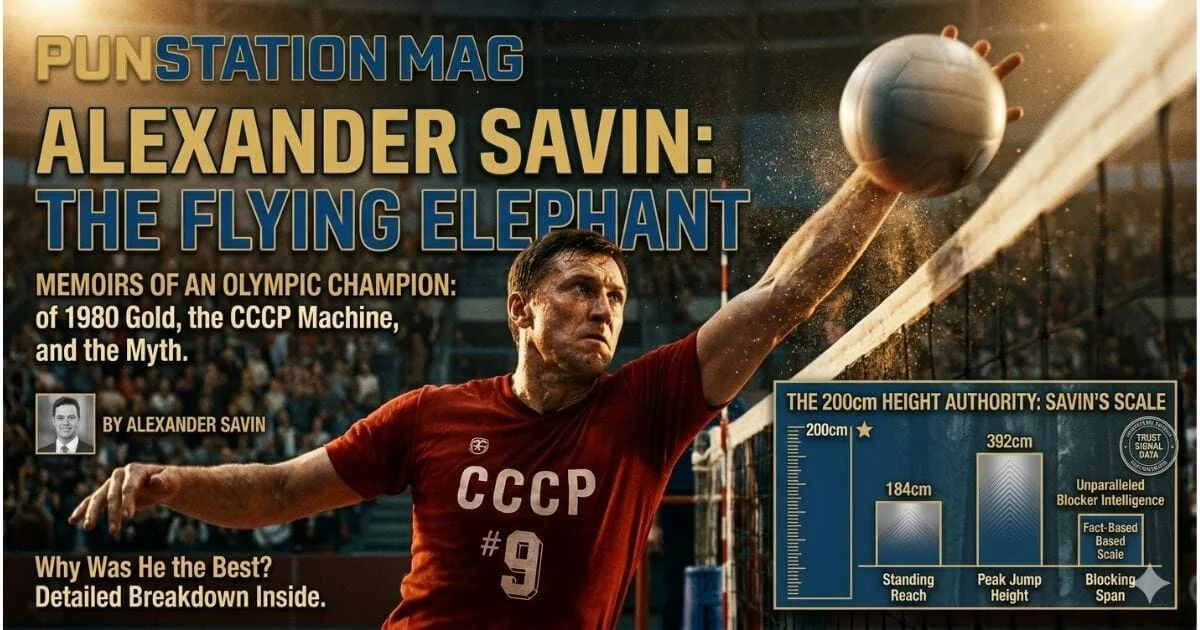
Imagine a man so tall he stood like a mountain at the net, yet leaped with the grace of a bird. This was Alexander Savin, the legendary Soviet volleyball star who shone brightest at the 1980 Olympics. His book, Alexander Savin The Flying Elephant Memoirs of an Olympic Champion, gives an honest look at the hard work, pain, and secrets behind true greatness.
Who Is Alexander Savin and What Is The Flying Elephant Memoirs of an Olympic Champion?
Alexander Savin is an Olympic gold medalist and a member of the International Volleyball Hall of Fame. He played for the Soviet Union as a powerful middle blocker. His memoir shares his real journey from a small-town boy to one of the greatest volleyball players in history. The English edition has 514 pages and includes more than 240 rare photographs from private family collections and public archives.
Why Does the Nickname “The Flying Elephant” Still Amaze Fans Today?
Most people do not connect elephants with grace. Yet for Alexander Savin, the name fit perfectly. At 200 cm tall, he was a strong force on the court, but he moved with surprising speed and lightness.
- Beautiful Contrast: He combined heavy power to block spikes with the ability to float through the air.
- Creating the Legend: Fans loved his “hang time” — he stayed in the air longer than others and waited for the perfect moment to strike.
- Power and Grace: The nickname perfectly describes his rare mix of raw strength and smooth movement.
From Small Town to Soviet Star: How Did Alexander Savin Start?
Alexander Savin was born in Taganrog, Russia. Life in the small town taught him that success requires hard work and never giving up.
Coaches at a local sports school noticed his height and quick reflexes. This discovery changed his life. He moved to CSKA Moscow, the top sports club in the Soviet Union. There he trained against the best players and began his rise to the world stage.
From Heartbreak in 1976 to Olympic Gold in 1980
In 1976, Savin’s team went to the Montreal Olympics as favorites but came home with only silver. That painful loss became fuel for the next four years.
The 1980 Moscow Olympics brought huge expectations. Playing in front of his own country added pressure, and many nations boycotted the Games. Still, the competition was tough. In the final against Bulgaria, Savin played with full focus. The Soviet Union won 3-1, and Savin finally stood on the top of the podium with his gold medal.
Career Dominance: Why Was Savin the Greatest of His Era?
From 1977 to 1983, Alexander Savin was almost unbeatable. Experts still call this period the Golden Age of Soviet volleyball.
Major Titles and Medals at a Glance
| Competition | Medal / Title |
| Olympic Games | Gold (1980), Silver (1976) |
| World Championships | Gold (1978, 1982) |
| European Championships | Gold (1975, 1977, 1979, 1981, 1983, 1985) |
| World Cup | Gold (1977, 1981) |
Savin once said, “To be the best, you must block out the noise and focus only on the ball.” His blocking was so sharp that opponents feared attacking near him.

What Was Life Like Inside the Strict Soviet Volleyball System?
Success came at a high cost. Training was very demanding. Players lived for months in isolated camps, far from their families.
A typical training day started early and lasted long. A typical day ran 6AM-10PM: 6AM sandbag jumps (2hrs), 9AM blocking drills (3hrs), 1PM film study, 3PM scrimmages (4hrs), 9PM team meetings. This routine repeated six days a week for many months. Savin built a legendary partnership with setter Vyacheslav Zaitsev. Zaitsev knew exactly where to place the ball for him. Yet constant government oversight and Cold War politics added heavy pressure. Winning was not just about sport — it was about national pride.
Alexander Savin’s Playing Style: What Are His Training Secrets?
Savin was a smart player. He did not only rely on jumping power — he read the eyes and hands of opponents to predict their moves. This intelligence made him very difficult to beat.
His training was old-school. He used heavy sandbags and repeated the same jumps thousands of times instead of modern machines.

Soviet Drills vs. Modern Volleyball Technology
| Training Feature | Savin’s Era (Soviet Drills) | Modern Training |
| Jumping | Jumping with heavy sandbags | Specialized plyometric boxes |
| Analysis | Hand-drawn notes and film | Instant AI video analysis |
| Recovery | Pushing through fatigue | Wearable sensors and rest days |
| Strategy | Focus on individual grit | Data-driven team tactics |
5 Actionable Techniques Savin Used
- Pre-jump timing drill: Stand at the net and count “one-thousand-one” before exploding upward. Savin practiced this 300 times daily.
- Setter eye reading method: Watch the setter’s shoulder angle and eye direction. Call the hitter’s position out loud during practice.
- 3-second recovery breathing: After every block, inhale for 3 seconds through the nose and exhale for 3 seconds to stay calm.
- Partner trust exercises: Practice blind blocks where one player closes his eyes and trusts his partner’s call.
- Mental visualization steps: Spend 10 minutes every night picturing perfect blocks against specific opponents.
Inside The Flying Elephant Memoirs of an Olympic Champion
This book is a special family project. Savin’s half-brother, Andrei Savine, helped bring the English edition to life so readers could hear the champion’s true voice.
Key chapters cover his first national team debut, the pain of the 1976 silver medal, the joy of the 1980 gold medal, life in training camps, team friendships, and his years after retirement. The 514-page book mixes personal stories with over 240 rare photos from five decades.
5 Modern Comparisons
Savin’s sandbag jumps built raw power that many modern athletes seek through cryotherapy. His hand-drawn film notes worked like today’s AI video analysis tools. Soviet isolation camps created strong team bonds similar to NBA bubble training. His repetitive drills developed mental toughness that players now train with sports psychologists. His anticipation skill still beats many data dashboards because it mixed sharp instinct with thousands of live repetitions.
Real Life Lessons That Still Help Readers Today
Savin openly shares how he fought self-doubt after the 1976 loss. He shows that giving up small comforts is necessary to reach big goals. He also stresses the power of teamwork — even the strongest player needs support. These lessons help anyone facing challenges in sport, work, or life.
Rare Stories and Photos That Bring the History to Life
The book stands out because of its personal photo collection. It contains over 240 rare images that show Savin laughing with teammates and looking tired after hard training.
Unpublished anecdotes reveal how players used humor to handle extreme stress. These human moments make the legend feel close and real.
Mental Toughness Checklist
| Habit | How Savin Did It | Your Action |
| Daily visualization | 10 minutes every night | Picture success before sleep |
| Recovery breathing | 3-second inhale/exhale | Use during stressful moments |
| Team trust | Blind block drills | Practice with a partner |
| Focus under noise | Blocked crowd sounds | Train with loud music |
Blocking Technique Steps
- Watch setter’s eyes
- Plant feet shoulder-width
- Time jump on “one-thousand-one”
- Hands penetrating over net
- Land balanced and ready again
Daily Discipline Habits
- Wake at 6:00 AM
- Complete sandbag session before breakfast
- Review one lesson from the book each evening
- Write three things you improved that day
Also Read: Glasgow Water Main Break Shettleston Road: What Really Happened & How to Protect Your Home
Who Should Read This Memoir and Why?
- Young Athletes: To learn the mindset of a world champion.
- History Fans: For a rare inside look at the Soviet Union and Cold War sports.
- Goal Seekers: To see how consistent hard work leads to success.
Reader Journey Map
Week 1: Read the early chapters and practice eye-reading drills 15 minutes daily.
Week 2: Continue reading and add sandbag jumps three times per week.
Week 3: Finish the full book and apply one lesson every single day. Track your progress in a notebook. By the end of three weeks, most readers notice better focus and stronger discipline.
Frequently Asked Questions
Where can I buy Savin’s memoir?
The Kindle edition is available on Amazon worldwide. Search “The Flying Elephant Memoirs of an Olympic Champion” for instant download.
What do the 240+ photos show?
They include training camp moments in snow, locker room celebrations, Olympic matches, and private family pictures spanning five decades.
What was Savin’s vertical jump like?
Standing reach 300cm + 92cm vertical jump that made him one of the highest jumpers of his era.
Why did the United States boycott the 1980 Olympics?
The US protested the Soviet invasion of Afghanistan. Over 60 countries joined the boycott.
How many European golds did Savin win?
Six consecutive titles: 1975, 1977, 1979, 1981, 1983, and 1985.
Is the book suitable for young players?
Yes. The simple language and practical lessons make it perfect for athletes aged 12 and above.
Does the memoir talk about mental health?
Yes. Savin openly discusses self-doubt, fear of failure, and life after the spotlight ends.
How long does it take to read the full book?
Most readers finish the 514-page edition in 8 to 12 hours spread over two to three weeks.
How to Buy and Get the Most Value from the Book
The digital Kindle version is available on major global websites. You can read it anywhere.
View the photos while reading each chapter. Keep the book close and return to the lessons whenever you need motivation.
Key Takeaways on Alexander Savin The Flying Elephant Memoirs of an Olympic Champion
- Savin is widely considered the best middle blocker in volleyball history.
- He earned the nickname “Flying Elephant” for his rare mix of power and jumping ability.
- The book reveals the tough reality of Soviet training and the drive to win.
- Actionable Tip: Practice Savin’s anticipation skill — learn to read situations early. It works in sports and everyday life.
You May Also Like: Glossywise Com: The Honest 2026 Review – What It Really Is, What It Offers & Is It Worth Your Time?
Disclaimer: This article is for sharing information only. We try our best to keep all facts about Alexander Savin correct and up to date. However, we are not the official publishers of his book. We do not provide professional sports or health advice. Always talk to a coach or doctor before starting any new or hard exercise routine.

Hi, I’m Emma Rose, the creative founder of Punstation.com. With a background in crafting hundreds of engaging guides and clever wordplay, I specialize in making complex information easy and fun to digest. Whether I’m exploring technical trends, lifestyle ideas, or creating my signature witty puns, my goal is to provide useful, well-researched content that helps solve problems and brings a smile to your face. For me, every topic, from tech to humor, is an opportunity to share clear, practical insights with a fresh perspective.